Why your website doesn't bring clients — and what brain research says about it
95% of all buying decisions are made unconsciously. If your web design ignores this principle, you systematically lose clients.
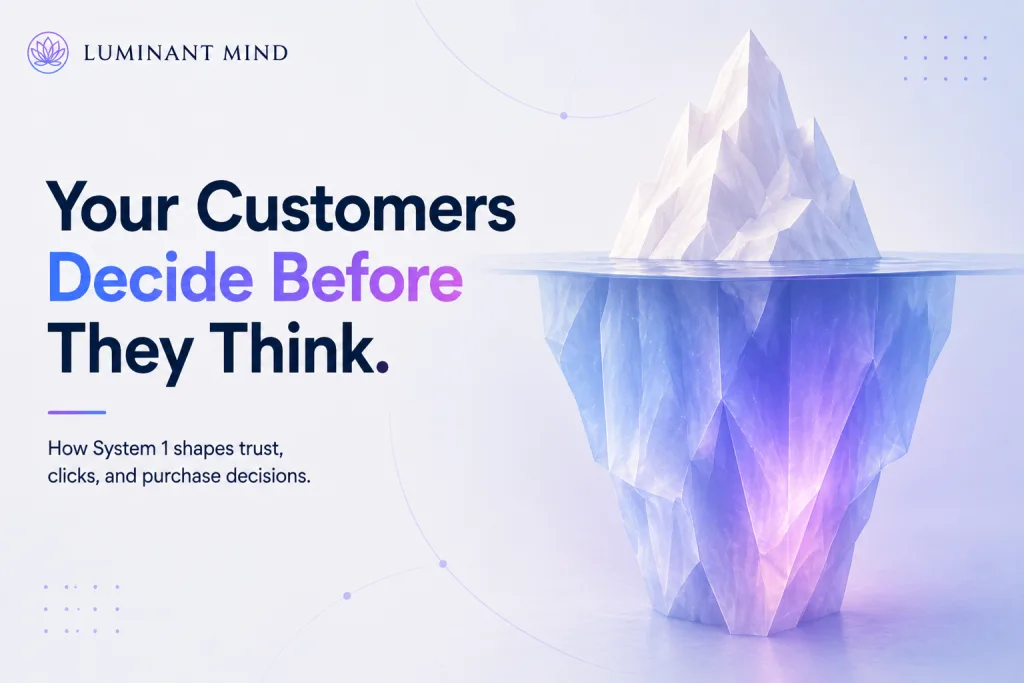
In modern e-commerce and web design, it is often wrongly assumed that customers rationally analyze offers, compare features, and then make a logical purchase decision. However, the reality of behavioral economics and brain research shows a contrary picture: the majority of our daily decisions are controlled unconsciously and emotionally, while the rational mind merely justifies these decisions after the fact.
Relevance of the topic
Understanding this mechanism is vital for businesses. If a website is designed to appeal exclusively to rational, effortful thinking, it overloads the visitor's brain. This leads to cognitive fatigue, hesitation, and ultimately the abandonment of the purchase or inquiry process. To maximize conversions, we must design web interfaces that harmonize with our brain's natural way of working.
Scientific background
The basis for this is the dual-process model of cognition. Our brain divides cognitive processes into two systems. System 1 works extremely fast, automatically, emotionally, and consumes almost no energy. It controls habits, intuitive reactions, and quick judgments. System 2, on the other hand, works slowly, logically, analytically, and consumes a lot of energy. Since our brain is evolutionary primed to save precious energy, the overwhelming majority of all decision-making processes run through System 1.
The study
The investigation of this phenomenon and the theoretical foundation of the two systems have been studied in numerous neuropsychological and behavioral economics studies. Pioneering in this regard was the research on cognitive heuristics and decision errors under uncertainty.
To what extent are human judgments and economic decisions guided by unconscious heuristics (System 1) compared to logical analyses (System 2)?
- Authors / institution
- Amos Tversky and Daniel Kahneman
- Year
- 1974
Setup and methodology
Over decades, the researchers conducted behavioral experiments in which participants had to estimate statistical probabilities, solve logical puzzles, or make financial decisions. Systematic deviations from rational decision models (cognitive biases) were documented. A well-known example is the study of how people rely on simplified heuristics when under time pressure or processing complex information.
Results
The experiments clearly proved that humans are not purely rational utility maximizers ('Homo oeconomicus'). About 95% of all purchasing decisions are made unconsciously by System 1. Only in exceptional cases, when System 1 cannot find a quick heuristic or explicitly generates cognitive friction, does the effortful System 2 kick in. Moreover, it was shown that unconscious stimuli, emotional framings, and social norms massively guide the behavior of the participants without them being aware of it.
What it means for perception
For perception and communication, this means that information must be easy to process. Science refers to this as 'Processing Fluency' (cognitive ease). The more smoothly the brain can process information, the more trustworthy, familiar, and positive System 1 rates this information. Visual clarity thus beats complex arguments in the first step of customer contact.
Applied to web design
For web design, it can be derived that user interfaces should be designed as simply and intuitively as possible. Any additional element, unclear navigation, or overly nested sentences forces the brain to activate the effortful System 2. This generates frustration and increases the bounce rate. A clear visual hierarchy, avoiding visual noise, and addressing emotions are essential to positively guide the user's autopilot.
Concrete examples
A concrete application example is reducing form fields in checkout or contact processes to an absolute minimum. Another example is the use of familiar icons and standard layouts (e.g., the shopping cart in the top right), as the brain can immediately process these learned patterns without cognitive effort. The consensus heuristic ('Customers also bought...') also leverages System 1's trust in other people's decisions.
Although the model of System 1 and System 2 is extremely useful in practice, it is a functional metaphor and not two physically separate brain regions. Furthermore, optimizing for System 1 alone does not automatically lead to long-term customer loyalty if the product or service does not withstand the rational criteria of System 2 during later verification.
Conclusion
Successful web design must not force the user to think unnecessarily. By maximizing cognitive ease and specifically addressing the emotional heuristics of System 1, we can significantly lower the barrier for a conversion. A design that relieves the brain wins the user's trust.
Source: Tversky & Kahneman (1974), Science 185(4157), 1124–1131
Want to know where your own site stands?
We look at your site and send you an assessment with a score — 10 areas, with a reason given for each point.
- our own software, not a third-party tool
- evaluated locally in Austria
- analysis without third-party AI
- revocable at any time
Keep reading

The Framing Effect: How context determines the value of your offer
How you present information is more important than the information itself. How to use framing to increase willingness to pay.

Cognitive Friction: Why complex design kills your sales
Every micro-second of thinking cost you conversion. How to audit and minimize friction on your website.